
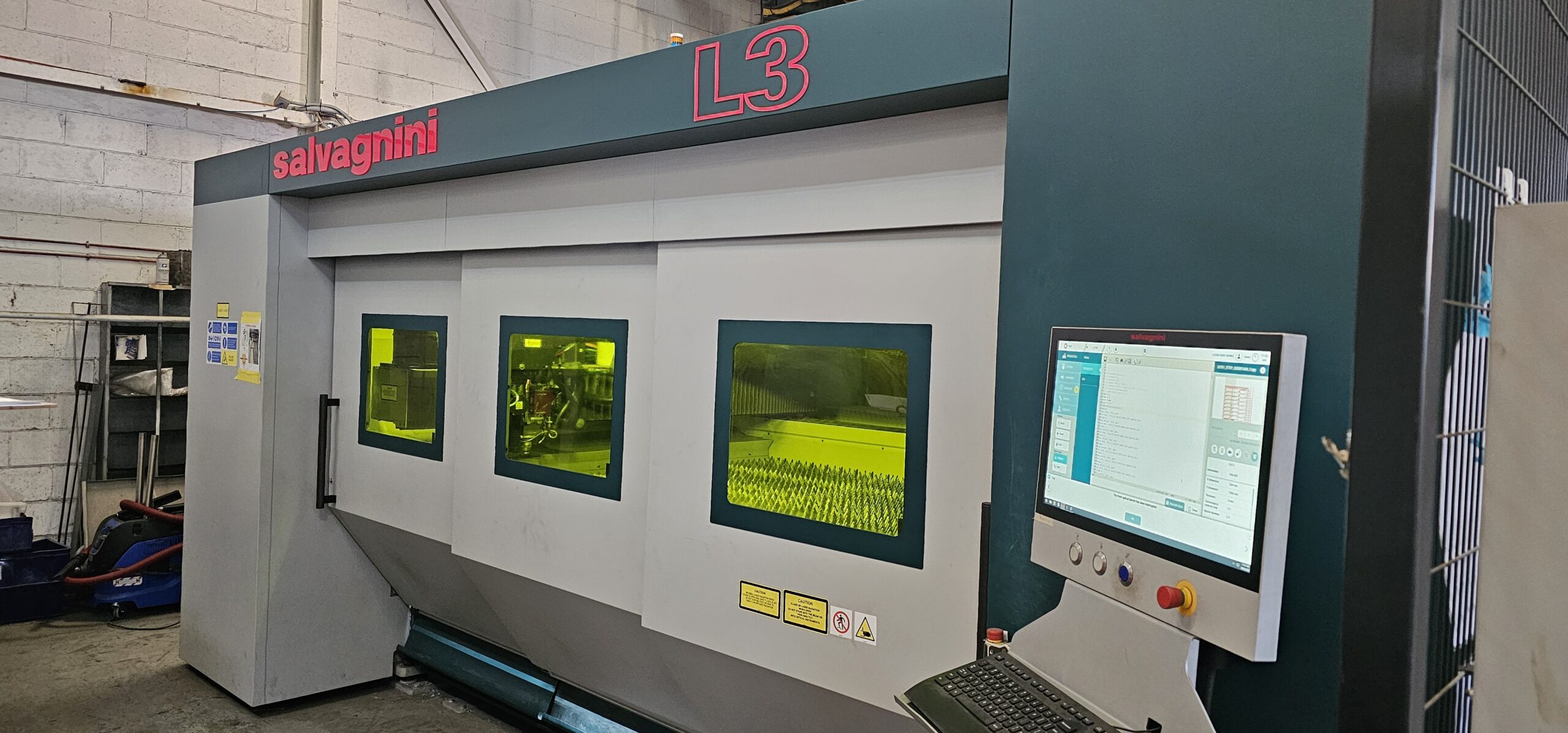
Cooks Body Works continually invests in technology to stay competitive in the industry and ensure high quality. When searching for a fibre laser, Salvagnini seemed like the perfect fit. As a pioneer in fibre laser technology with local after-sales service and support, the decision to partner with Salvagnini was clear.
Prior to the commissioning of the fibre laser, Cooks produced blank sheet metal parts via a turret punch. Using fibre laser cutting over turret punching for producing sheet metal parts offers several significant advantages in terms of precision, efficiency, and versatility.
Precision and Quality
Fibre lasers produce highly concentrated beams with minimal diffraction, resulting in precise cuts with sharp edges and smooth surfaces. This eliminates the need for post-processing, enhancing productivity and efficiency. In contrast, turret punching can leave burrs and rough edges that often require additional finishing.
Speed and Efficiency
Fibre laser cutting is generally faster than turret punching, especially for complex shapes and intricate designs. With 900mm/s on 2mm Aluminium, processing capabilities of fibre lasers reduce production time, making them ideal for volume manufacturing and rapid prototyping. Turret punching, while effective for simpler tasks, can be slower due to the need for tool changes and repositioning.
Flexibility and Versatility
Fibre lasers can cut a wide range of materials and thicknesses with ease, including metals like stainless steel, aluminium, and galvanised steel. With the use of software, they are capable of nesting parts to maximise sheet usage and minimise waste. Fibre laser is also capable of cutting intricate patterns and fine details that turret punches cannot achieve. This versatility makes fibre lasers ideal for low volume complex part creation
Lower Maintenance and Operating Costs
Fibre lasers have fewer moving parts and do not require the frequent tool changes that turret punches do. This results in lower maintenance costs and less downtime. Additionally, fibre lasers cut using compressed air and are more energy-efficient, leading to reduced operating costs over time.
Automation and Integration
Fibre laser systems can be easily integrated into automated and semi-automated production lines, enhancing overall workflow and reducing the need for manual intervention. This level of automation is harder to achieve with turret punching systems, which are more reliant on manual setup and operation.
In summary, the installation of the fibre laser at Cooks Body Works has demonstrated superior precision, speed, and versatility compared to turret punching. These benefits make it a more efficient and cost-effective choice for producing high-quality sheet metal parts, especially in a low volume, custom built environment